UD Impact, led by CEO Jung-heon Kim, hosted a session at SOVAC 2026 under the theme “LOCAL FOURCAST – Four Forces for Sustainable Communities.”
The session was designed to examine diverse regional revitalization cases from Korea and Japan through four perspectives—PARTNERSHIP, CONTENTS, CAPITAL, and PEOPLE—and to discuss how sustainable local ecosystems can be built when these elements are organically connected. In particular, the session focused on the conditions needed for relationships, experiences, and execution capabilities within a region to accumulate over the long term, moving beyond the performance of individual spaces or one-off projects.
A key feature of the session was that the four presentations were not treated as separate cases, but connected into a single flow: Partnership → Contents → Capital → People. The discussion began with industry-academia collaboration and solutions to local challenges, then moved to content and spaces that activate communities, capital and governance that sustain local implementation organizations, and finally the people and networks that remain in the region after projects end and generate the next round of action. In this way, the session examined the broader local ecosystem as one interconnected structure.
Dae-eun Park, Partner at UD Impact, served as moderator for the entire session. In the first PARTNERSHIP session, Kazuhiro Fujitsuka of Mitsui Fudosan shared examples of solving local challenges and building regional ecosystems through industry-academia collaboration with local universities. This was followed by the CONTENTS session, in which Young-gyu Shim, Director at Urbanplay, discussed the role of content that activates spaces and the importance of local creators.
In the third CAPITAL session, Tae-jun Shin, CEO of Gojo & Company, spoke on capital, trust, and governance as key elements for sustaining local implementation organizations. In the final PEOPLE session, Cheol-woo Kim, CEO of RTBP Alliance, shared field-based insights on the execution systems and networks that remain in communities even after individual projects have ended.
The speakers’ respective areas of expertise also broadened the perspectives through which regional revitalization was discussed. Mitsui Fudosan focuses on real estate development and industry-academia collaboration; Urbanplay on urban and spatial content and commercial district revitalization; Gojo & Company on finance and social impact; and RTBP Alliance on urban regeneration, spatial and cultural content, and building local entrepreneurial ecosystems centered on Yeongdo, Busan.
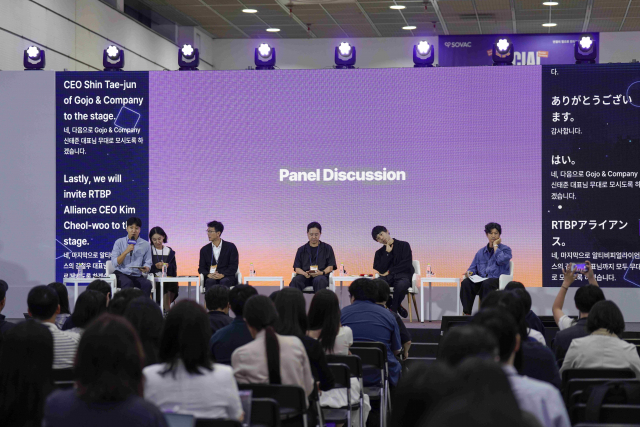
Following the individual presentations, all four speakers joined a panel discussion titled “FINAL FOURCAST | Where Do the Four Perspectives Meet?” The discussion explored where regional revitalization should begin, how external companies and capital can contribute without undermining local agency, and what needs to remain in a community in order to turn the outcomes of short-term projects into long-term execution capabilities and relationship-based assets.
With experts from Korea and Japan working across different fields gathered in one place, participants also showed strong interest in how the cases presented could be applied to actual regions and projects. During the panel discussion, a wide range of perspectives were exchanged on the roles of companies and local stakeholders, partnership models that preserve local agency, and the types of assets that should remain in the community after a project ends.
The session also featured a pitch by Kaoru Hirabayashi, CEO of Strout Inc. in Japan. Hirabayashi introduced a smart aquaculture solution that combines practical know-how from his family’s aquaculture business with AI and IoT technologies, presenting a new approach to connecting technology with local industries.
UD Impact stated that regional revitalization cannot be sustained simply by creating a single space or operating a short-term project. Sustainable change becomes possible when stakeholders inside and outside the community build relationships, content gives people reasons to visit and stay, capital supports continued implementation, and people remain to carry forward the next project.
The company added that through its SOVAC session, it aimed to connect diverse field experiences from Korea and Japan and explore how companies and local stakeholders can build long-term partnerships while respecting the agency of local communities.
Meanwhile, UD Impact also hosted a session titled “Corporate Social Contribution: What Kind of Talent Should We Develop?” under the broader theme “The New Role of Corporate Social Contribution and Future Talent Development.” The session examined how the qualities required of talent are changing in response to AI and broader social and environmental shifts, and discussed through a range of cases and perspectives how corporate social contribution initiatives can help people experience and develop capabilities that are difficult to cultivate through knowledge alone, including problem discovery, problem solving, collaboration, and execution.
Source: https://www.kmkj.kr/news/articleView.html?idxno=137271





UD Impact, led by CEO Jung-heon Kim, hosted a session at SOVAC 2026 under the theme “LOCAL FOURCAST – Four Forces for Sustainable Communities.”
The session was designed to examine diverse regional revitalization cases from Korea and Japan through four perspectives—PARTNERSHIP, CONTENTS, CAPITAL, and PEOPLE—and to discuss how sustainable local ecosystems can be built when these elements are organically connected. In particular, the session focused on the conditions needed for relationships, experiences, and execution capabilities within a region to accumulate over the long term, moving beyond the performance of individual spaces or one-off projects.
A key feature of the session was that the four presentations were not treated as separate cases, but connected into a single flow: Partnership → Contents → Capital → People. The discussion began with industry-academia collaboration and solutions to local challenges, then moved to content and spaces that activate communities, capital and governance that sustain local implementation organizations, and finally the people and networks that remain in the region after projects end and generate the next round of action. In this way, the session examined the broader local ecosystem as one interconnected structure.
Dae-eun Park, Partner at UD Impact, served as moderator for the entire session. In the first PARTNERSHIP session, Kazuhiro Fujitsuka of Mitsui Fudosan shared examples of solving local challenges and building regional ecosystems through industry-academia collaboration with local universities. This was followed by the CONTENTS session, in which Young-gyu Shim, Director at Urbanplay, discussed the role of content that activates spaces and the importance of local creators.
In the third CAPITAL session, Tae-jun Shin, CEO of Gojo & Company, spoke on capital, trust, and governance as key elements for sustaining local implementation organizations. In the final PEOPLE session, Cheol-woo Kim, CEO of RTBP Alliance, shared field-based insights on the execution systems and networks that remain in communities even after individual projects have ended.
The speakers’ respective areas of expertise also broadened the perspectives through which regional revitalization was discussed. Mitsui Fudosan focuses on real estate development and industry-academia collaboration; Urbanplay on urban and spatial content and commercial district revitalization; Gojo & Company on finance and social impact; and RTBP Alliance on urban regeneration, spatial and cultural content, and building local entrepreneurial ecosystems centered on Yeongdo, Busan.
Following the individual presentations, all four speakers joined a panel discussion titled “FINAL FOURCAST | Where Do the Four Perspectives Meet?” The discussion explored where regional revitalization should begin, how external companies and capital can contribute without undermining local agency, and what needs to remain in a community in order to turn the outcomes of short-term projects into long-term execution capabilities and relationship-based assets.
With experts from Korea and Japan working across different fields gathered in one place, participants also showed strong interest in how the cases presented could be applied to actual regions and projects. During the panel discussion, a wide range of perspectives were exchanged on the roles of companies and local stakeholders, partnership models that preserve local agency, and the types of assets that should remain in the community after a project ends.
The session also featured a pitch by Kaoru Hirabayashi, CEO of Strout Inc. in Japan. Hirabayashi introduced a smart aquaculture solution that combines practical know-how from his family’s aquaculture business with AI and IoT technologies, presenting a new approach to connecting technology with local industries.
UD Impact stated that regional revitalization cannot be sustained simply by creating a single space or operating a short-term project. Sustainable change becomes possible when stakeholders inside and outside the community build relationships, content gives people reasons to visit and stay, capital supports continued implementation, and people remain to carry forward the next project.
The company added that through its SOVAC session, it aimed to connect diverse field experiences from Korea and Japan and explore how companies and local stakeholders can build long-term partnerships while respecting the agency of local communities.
Meanwhile, UD Impact also hosted a session titled “Corporate Social Contribution: What Kind of Talent Should We Develop?” under the broader theme “The New Role of Corporate Social Contribution and Future Talent Development.” The session examined how the qualities required of talent are changing in response to AI and broader social and environmental shifts, and discussed through a range of cases and perspectives how corporate social contribution initiatives can help people experience and develop capabilities that are difficult to cultivate through knowledge alone, including problem discovery, problem solving, collaboration, and execution.
Source: https://www.kmkj.kr/news/articleView.html?idxno=137271